
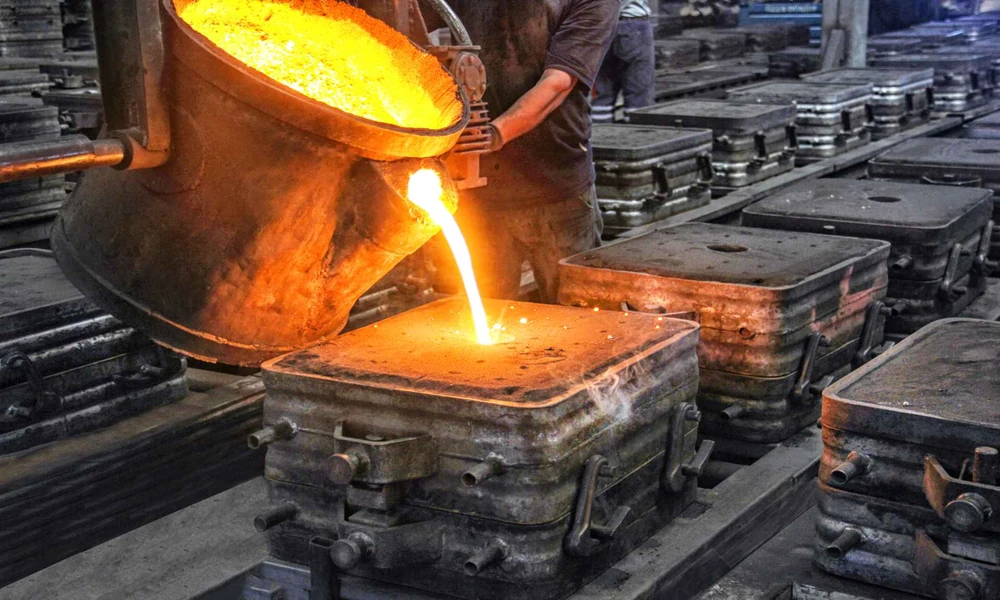
Cast iron has been shaped in sand molds for centuries, and it still sits inside pumps, compressors, gearboxes, machine tool beds, valve bodies and countless pieces of municipal hardware. Sourcing parts from an iron castings manufacturer goes far more smoothly once you know how the metal is poured, which grade fits which job and where a custom casting earns its keep over a part built some other way.
Iron is forgiving to cast. It melts at a lower temperature than steel, flows well into thin sections and shrinks less as it solidifies. Those traits explain why so many heavy, complex shapes are still poured rather than cut from solid stock or welded together from plate.
How Does an Iron Castings Manufacturer Turn a Drawing into a Part?
The process starts with a pattern, a full-size replica of the part made from wood, plastic, resin or metal. The pattern is slightly oversized to allow for shrinkage and has extra stock on surfaces that will be machined later. Molders pack sand around it, most often green sand bonded with clay and water, or chemically bonded sand when better dimensional accuracy is needed. Internal passages are formed with sand cores set into the mold before it closes.
Meanwhile the iron is melted, commonly in an induction or cupola furnace, and its chemistry is checked and adjusted. Metal is poured through a gating system designed to fill the cavity smoothly, with risers that feed extra metal into heavy sections as they shrink. After cooling, the casting is shaken out of the sand, the gates and risers are removed, and the surface is cleaned by shot blasting. Many parts then go to heat treatment, machining and inspection before they ship. An experienced iron casting company spends much of its engineering effort on that gating and feeding design, because it decides whether the finished part is sound inside.
What Is the Difference Between Gray Iron and Ductile Iron?
Both are iron with a high carbon content, typically a few percent, but the shape of the graphite inside them changes everything. In gray iron the graphite forms as flakes. Those flakes give gray iron excellent machinability, very good vibration damping and strong compressive performance, which is why it is used for machine bases, brake components and engine blocks. The tradeoff is low ductility: gray iron can crack rather than bend under impact.
In the United States, gray iron is often specified under ASTM A48, where the class number reflects minimum tensile strength in thousands of pounds per square inch. A Class 30 casting, for example, must reach at least 30 ksi in tension on its test bar.
Ductile iron is made by treating molten iron, usually with magnesium, so the graphite forms as small spheres instead of flakes. The result is a material that can stretch before it breaks, with tensile strength much closer to some steels. ASTM A536 covers ductile iron, and its grade names list three minimums. Grade 65-45-12 means 65 ksi tensile strength, 45 ksi yield strength and 12 percent elongation. Ductile iron is common in pipe fittings, suspension parts, gears, crankshafts and hydraulic components.
When Do Custom Iron Castings Make More Sense than Other Options?
Custom iron castings pay off when a part has a shape that would be wasteful or slow to make any other way. Internal passages, curved walls, ribs, bosses and varying section thicknesses can all be produced in one pour. Cutting the same geometry from solid bar would turn most of the material into chips, and welding it from plate would add labor, distortion and inspection.
Volume matters too. Pattern and core box costs are spread over the production run, so castings become more attractive as quantities rise into the dozens, hundreds or thousands per year. Material properties are another reason. If a part needs the damping of gray iron, such as a machine tool base, or the wear resistance and pressure tightness that iron offers in pump and valve housings, casting delivers those properties in a near-net shape.
Castings make less sense for very low quantities of simple shapes, or for parts that need high toughness at low temperatures, heavy impact loading or extensive welding during repair. In those cases another material or process may serve better. It also pays to involve the foundry before the design is frozen, since small changes to draft angles, wall transitions and fillet radii can make a casting easier to pour and less prone to shrinkage defects.
How Does Steel Casting Compare with Iron?
A steel casting carries much less carbon than iron, which gives it higher toughness and better weldability. Steel is also harder to pour. It melts at a higher temperature, shrinks more during solidification and needs larger risers, so yields are lower and costs per pound tend to be higher. For many housings, brackets and frames that do not see shock loads, iron delivers the needed strength at a lower cost and with easier machining.
What Do Industrial Iron Castings Need in Terms of Testing and Inspection?
Industrial iron castings that go into pressure equipment, rotating machinery or safety-related assemblies usually need more than a visual check. Chemistry is verified for each melt. Separately poured or attached test bars are pulled to confirm tensile values. For ductile iron, microstructure checks confirm the graphite nodule count and shape, since poorly formed nodules lower strength and elongation.
Dimensional inspection compares the casting to the drawing, often with a coordinate measuring machine on the first articles. Nondestructive testing may include magnetic particle inspection for surface cracks, ultrasonic testing for internal flaws and radiography on critical areas. Pressure-containing parts such as valve bodies may also be leak tested after machining. Specify which tests you need on the drawing or purchase order, because a foundry will quote and plan to the stated requirements.
Why Does Foundry Choice Matter for Repeat Iron Casting Orders?
Look for a foundry whose molding method and size range match your parts, and ask for sample inspection reports and material certifications from similar jobs. Confirm who owns the pattern, how it is stored and how wear will be tracked over a long production life. Share annual volumes, critical dimensions and machining surfaces early so the foundry can design gating and machining stock around them. Most casting defects trace back to a grade, gating or machining allowance that was settled too late, so early agreement on those points pays off across every repeat order.