
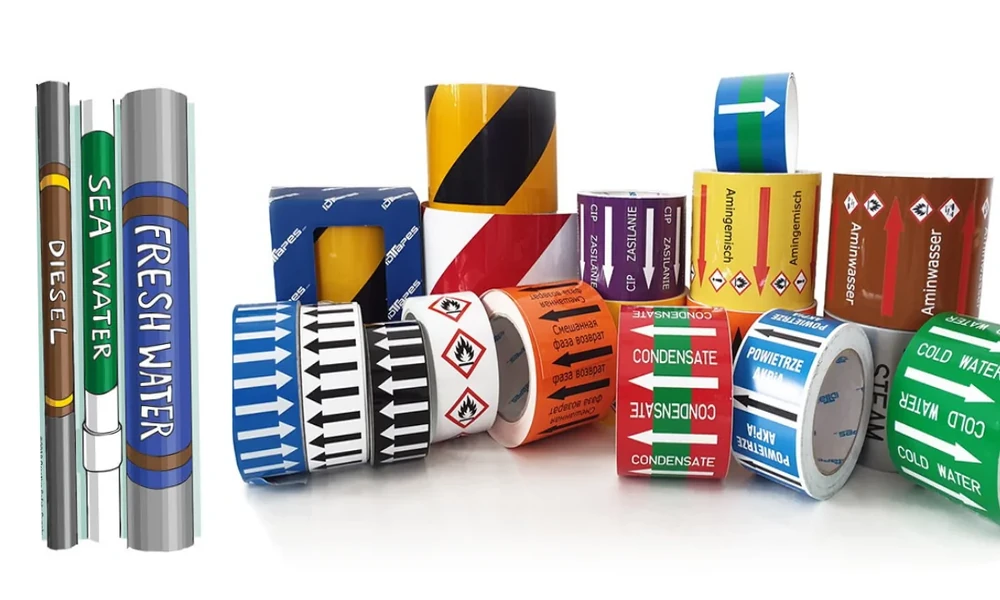
Pipe identification tape provides important markers across a wide range of industries. With proper pipe ID tape, you can organise efficiently to ensure the safety of workers in potentially hazardous working environments. It allows operators, maintenance personnel, and other workers to quickly and accurately identify what is inside a pipe or pipe system. With this information it makes it significantly safer to work, whilst maintaining compliance with health and safety and industry-specific regulations.
Why should you implement pipe ID?
The implementation of pipe identification tape is important across multiple industries. It is used to keep workers safe during everyday operation of industrial applications, allowing for quick and clear identification of pipework, preventing accidents. In emergency situations it helps to speed up the response times, helping to lower the instances of long-term injuries through fast action. Maintenance time is also reduced, minimising costly downtime on site through a standardisation of how hazards are communicated and displayed on site.
To organise a safe pipe marking system there are a few different factors to consider.
What are the components of pipe identification tape?
There are four main components of pipe identification tape:
- The basic colour that is used to identify the contents of the pipe. For example, green is used to identify water, silver grey is used for steam, and violet is used for acids.
- On the pipe identification tape should be clearly marked the full name, the chemical formula, or the universally understood abbreviation of the substance inside, using a contrasting sans-serif font.
- To understand how systems operate, clear flow-direction arrows must be clear, indicating the exact path of the contents to prevent dangerous backflow.
- For hazard perception and awareness, clear warning symbols from the Global Harmonised System (GHS) or ISO 7010 warning systems must be included.
How to place the label
The visibility of pipe identification tape is crucial to its effectiveness. Workers must be able to quickly and accurately identify what’s inside the pipes, based on the information that must be included that we’ve mentioned above. Markers should be placed every:
- 6-15 metres (20-50 feet) depending on whether the pipe system is inside or outside.
- Immediately before and after any valves, flanges, and T-junctions.
- On both sides of a wall, ceiling, or floor where a pipe passes through.
- Any bend or change in direction for the layout of the pipe system.
What about compliance and standards?
There are different compliance and standards to be aware of depending on the industry you work in and the type of content within the pipework. UK Standard BS 1710 is the standard basic identification colours and banding that must be adhered to at all times. There are also European and Global Standards, US standards, and industry-specific regulations to be aware of.
Should I train my workforce to know about pipe ID markers?
The pipe identification tape and its placement is only the beginning of its effectiveness. Training your workforce to understand its importance and what each identification colour and symbol means will help to make a more efficient system. For the safety of workers, maintenance operations, and visitors, it’s important to have basic training, a facility-wide chart or key, and for there to be routine inspections to replace any fading, damaged, or incorrect pipe identification tape.
Pipe ID markers and tape play a crucial role in the safety of myriad workplaces and industries. Ensure you have the correct pipe identification tape to secure your employees and minimise the potential for accidents and injuries.