
The Blueprint: Building Your Digital Marketing Strategy from the Ground Up
In today’s business world, having a great product or service alone is no longer enough. To truly thrive and expand, businesses need a strong online presence. We’ve seen a significant shift from traditional marketing methods to new digital ones. For us, this means we must have smart digital marketing strategies. These help us reach customers, build our brand, and grow from a small niche to a broader market.
This guide will show you how to build and scale your digital marketing efforts. We will explore everything from understanding your audience to using the right tools and measuring your success. Our goal is to give you a clear plan. This plan will help any business expand its online presence and achieve sustainable growth.
Whether you are just starting or looking to expand, understanding these expert digital marketing strategies is crucial. They can help turn your business into a major player in your field. To see how these principles apply to specific industries, such as developing effective roofing digital strategies, requires a custom approach to online visibility and customer engagement. We believe that with the right approach, any business can master its digital presence and achieve significant results.
The transition from traditional marketing to digital marketing is not merely a change in medium; it’s a fundamental shift in how businesses connect with their audience. Gone are the days when door-knocking or newspaper ads were sufficient. Today, nearly 90 percent of people have access to the internet, and a significant portion of their daily lives is spent online. This means that to reach potential customers effectively, businesses must meet them where they are: in the digital field.
A well-defined digital marketing strategy is the roadmap for this journey. It’s more than just a collection of tactics; it’s a comprehensive plan that outlines your goals, identifies your target audience, and details the specific actions you’ll take to achieve your objectives online. Without a clear strategy, marketing efforts can become fragmented and inefficient. In fact, research shows that 45 percent of businesses lack a clear and defined digital marketing strategy, often resulting in wasted resources and missed opportunities.
Understanding the difference between strategy, tactics, and campaigns is vital. A strategy is your overarching long-term plan to achieve a primary objective (e.g., “become the leading roofing contractor in our service area”). Tactics are the specific actions you take to implement that strategy (e.g., “optimize our website for local SEO,” “run targeted Facebook ads”). Campaigns are time-bound initiatives designed to achieve a specific objective within your strategy (e.g., “a 3-month campaign to generate leads for roof inspections”). Each component plays a crucial role, working together to move your business forward.
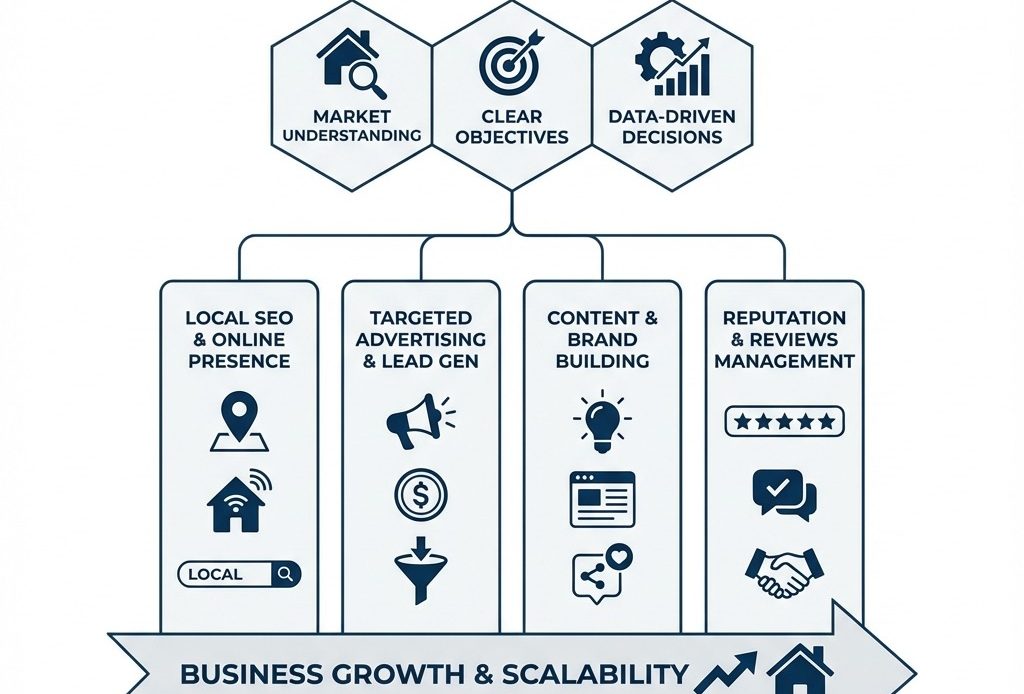
To illustrate the foundational elements that underpin successful digital marketing, especially for home service businesses, consider the following:
Building a robust digital marketing strategy is akin to constructing a sturdy building; it requires a solid blueprint and careful planning before any execution begins. The core components of a successful digital marketing strategy revolve around understanding your market, setting clear objectives, and making data-driven decisions. This foundational work ensures that every subsequent action is purposeful and contributes to your overall business growth.
We start by recognizing that a successful strategy isn’t a one-size-fits-all solution. The components of an ideal digital marketing strategy can vary significantly from organization to organization, often based on overall business objectives, specific marketing goals, culture, product offerings, and revenue targets. For a roofing company, this might mean focusing on emergency repairs during storm season versus long-term maintenance contracts in calmer periods.
Step 1: Define Your Ideal Customer (Not Just “Homeowners”)
One of the most critical initial steps in crafting an effective digital marketing strategy is to understand who you are trying to reach deeply. It’s not enough to say “homeowners” or “businesses.” We need to go much deeper, creating detailed buyer personas that represent your ideal customers. These personas are semi-fictional representations of your ideal customers based on market research and real data about your existing customers.
Consider:
- Demographics: Age, income, location (e.g., urban vs. suburban), property type.
- Psychographics: Hobbies, interests, values, concerns (e.g., energy efficiency, curb appeal, durability).
- Pain Points: What problems do they face related to your services? (e.g., leaky roof, outdated aesthetics, high energy bills).
- Goals: What do they hope to achieve? (e.g., a safe home, increased property value, peace of mind).
- Online Behavior: Where do they spend their time online? What search terms do they use?
For a roofing business, defining your ideal customer might involve distinguishing between a homeowner seeking a minor repair versus a commercial property manager needing a full roof replacement. The messaging and channels for these two personas would be vastly different. For instance, a homeowner might be more influenced by local reviews and community recommendations, while a commercial client might prioritize certifications, insurance, and project management capabilities.
We leverage tools such as customer surveys (e.g., Google Surveys, Typeform), social media audience insights (e.g., Facebook Audience Insights), and online communities like Reddit to uncover these nuances. These insights enable us to tailor our messaging and select the most effective channels to reach them. For a comprehensive guide on creating buyer personas that truly resonate, we often refer to an authoritative guide on creating buyer personas. By understanding your customers intimately, you can craft engaging content and targeted campaigns that speak directly to their needs and motivations.
Step 2: Set SMART Goals and Identify Key KPIs
Once you know who you’re speaking to, the next step is to define what success looks like for them. This is where the SMART goals framework comes into play:
- Specific: Clearly define what you want to achieve. (e.g., “Increase leads for roof replacements”).
- Measurable: Quantify your goal to track progress effectively. (e.g., “Increase leads by 20%”).
- Achievable: Set realistic goals that are within reach. (e.g., “Increase leads by 20% within the next quarter”).
- Relevant: Ensure the goal aligns with your broader business objectives. (e.g., “Increase leads by 20% to boost revenue for our roof replacement division”).
- Time-bound: Establish a deadline for achieving the goal. (e.g., “Increase leads by 20% within the next quarter to boost revenue for our roof replacement division”).
Along with SMART goals, we identify Key Performance Indicators (KPIs) – the specific metrics that will indicate whether we’re on track. For a roofing contractor, these might include:
- Leads from calls: How many potential customers contacted us directly?
- Website form fills: How many inquiries came through our website?
- Cost per lead (CPL): How much does it cost to acquire each new lead?
- Conversion rate: What percentage of leads turn into paying customers?
- Website traffic: How many visitors are coming to our site?
- Google Business Profile views/actions: How many people are finding us on Google Maps and calling or visiting our website?
By focusing on these measurable outcomes, we ensure that our digital marketing efforts are directly contributing to revenue and business growth. It’s not just about vanity metrics; it’s about tracking what truly matters for your bottom line. For more insights on how to effectively track and generate leads, you can explore resources on mastering SEO for lead generation success.
Step 3: Audit Your Current Online Presence and Competitors
Before launching into new strategies, it’s crucial to understand your starting point and the competitive landscape. This involves a thorough audit of your existing digital assets and a comprehensive examination of what your competitors are doing well (and not so well).
A comprehensive audit includes:
- Your Website: Is it mobile-friendly, fast-loading, secure, and easy to navigate? Is your content optimized for search engines? Are there clear calls to action on every key page, and is there an intuitive path for users to contact you or request a quote?
- Google Business Profile (GBP): Is it fully optimized with accurate information, photos, and positive reviews? Are you using attributes (such as “women-owned” or “veteran-owned”) where appropriate and adding products or services so that searchers can quickly see what you offer?
- Social Media Presence: Which platforms are you on? Is your content engaging? Are you actively responding to comments and messages? Do your profiles consistently feature your brand, include up-to-date contact information, and include links back to your website?
- Online Reviews: What is your overall rating? Are you actively soliciting and responding to reviews across various platforms, including Google, Yelp, and industry-specific sites? Do you have a process in place for handling negative feedback and turning unhappy customers into advocates when possible?
- Current SEO Performance: What keywords are you ranking for? What is your organic traffic like? Are there technical issues, such as broken links, duplicate content, or missing title tags, that could be holding you back?
Next, we conduct a competitor analysis. This isn’t about copying them, but understanding their strengths and weaknesses to identify opportunities for differentiation. We look at:
- Their Website: What is their user experience like? What content do they publish? Do they highlight guarantees, warranties, or financing options that appeal to your shared audience?
- Their SEO: What keywords do they rank for? Do they have a strong backlink profile? Are they creating location-specific pages or blog content that draws in local traffic?
- Their Social Media: Which platforms do they prioritize? What kind of engagement do they get? Are they using video, Stories, or live streams to connect with followers in a more personal way?
- Their Paid Ads: Are they running Google Ads or social media campaigns? What kind of offers are they promoting? Are they focusing on emergency services, seasonal discounts, or educational content that leads to a consultation?
This analysis often involves a SWOT (Strengths, Weaknesses, Opportunities, Threats) assessment, helping us pinpoint areas where we can excel or where we need to improve. For example, if our competitors have weak technical SEO, that presents an opportunity for us to gain an edge. If they dominate a specific keyword, we might target related long-tail keywords. Understanding your competitive landscape is vital for carving out your unique space in the digital market. If you’re struggling to understand why your website isn’t performing, diagnosing your roofing website’s ranking woes can provide valuable insights.
Finally, we translate the findings from your audit and competitor review into a prioritized action plan. This might include quick wins, such as updating meta tags or fixing broken pages, alongside longer-term initiatives like building a library of educational content or redesigning your site for better usability. By sequencing these improvements logically and assigning realistic timelines, your digital strategy becomes more manageable and far more likely to deliver meaningful, sustainable results.
Foundational Strategies: Dominating Your Local Service Area
For many home service businesses, especially those just starting or operating in a specific geographic region, dominating the local market is paramount. These foundational digital marketing strategies are often the most cost-effective and yield high-impact results by building a strong local footprint and ensuring you’re visible to customers actively searching for your services in your area. These are essential strategies for new businesses looking to establish their presence.
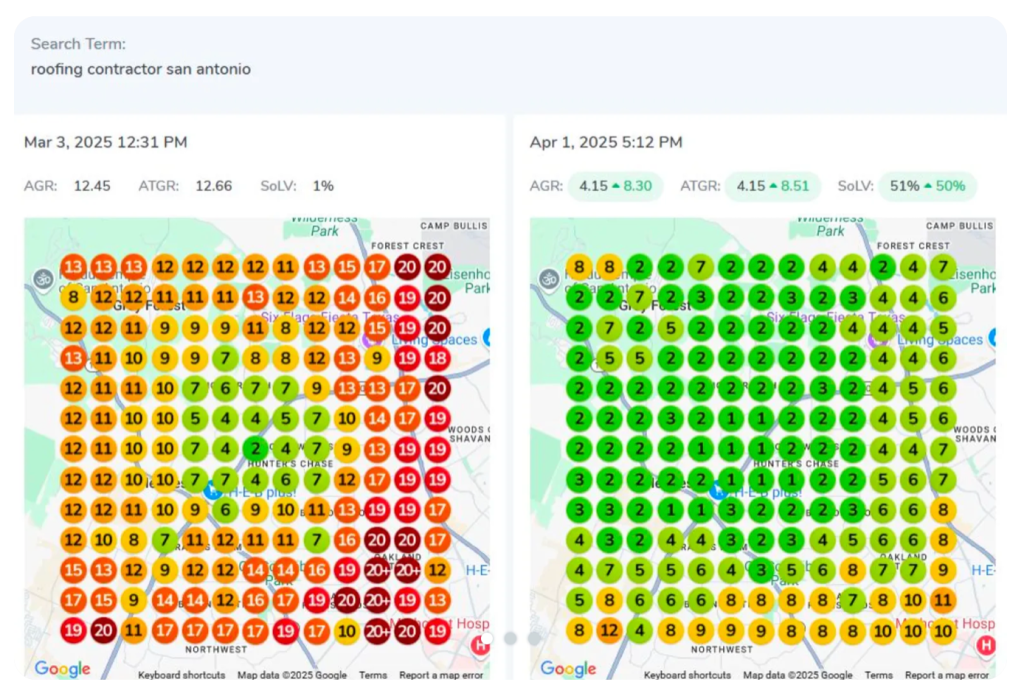
The Bedrock of Your Online Presence: SEO Digital Marketing Strategies
Search Engine Optimization (SEO) is the process of optimizing your website to rank higher in search engine results pages (SERPs) for relevant queries. For a roofing company, this means appearing prominently when someone searches for “roof repair [your city]” or “best roofing company near me.” SEO is a long-term strategy that builds consistent, organic traffic to your site.
We break SEO down into three main pillars:
- On-page SEO: Optimizing elements directly on your website, such as content, keywords, meta descriptions, title tags, and image alt text. For example, ensure your service pages clearly state “roof replacement services in [city, state]” and provide detailed, helpful information.
- Off-page SEO: Activities done outside your website to improve its ranking, primarily by building high-quality backlinks from other reputable websites. This signals to search engines that your site is trustworthy and authoritative.
- Technical SEO: Ensuring your website’s backend is optimized for search engine crawlers. This includes site speed, mobile-friendliness, site structure, and schema markup (structured data that helps search engines understand your content).
The goal of SEO is not just to rank, but to rank for the right keywords – those that indicate high intent from potential customers. We research the words and phrases that consumers use to search for information online and incorporate those terms into our content. For a deep dive into optimizing your online presence, especially for the home services sector, exploring resources on Roofing SEO can be incredibly beneficial. This includes understanding the specific keywords for roofers that drive traffic and how to effectively implement website optimization techniques.
Google Business Profile (GBP) & Local Map Pack Mastery
For local businesses, your Google Business Profile (formerly Google My Business) is arguably your most important digital asset. It’s the information hub that appears in Google Maps and the local “3-pack” in regular search results, providing crucial details like your address, phone number, hours, website, and customer reviews.
Optimizing your GBP profile is non-negotiable. This involves:
- Claiming and verifying your listing: Ensure all information is accurate and up-to-date.
- Adding high-quality photos: Showcase your work, team, and facilities.
- Choosing relevant categories: Help Google understand what services you offer.
- Writing a compelling business description: Highlight your unique selling propositions.
- Posting regularly: Share updates, offers, and photos to keep your profile active.
Generating customer reviews is equally critical. Online reviews are how most consumers decide which products to purchase and which businesses to trust with their money. We actively encourage satisfied customers to leave reviews, and we respond to all reviews, positive or negative, to demonstrate our commitment to customer service. This not only boosts your ranking in the local pack but also builds trust with potential clients. To truly stand out and make your competitors jealous in the local search arena, understanding how to win at SEO for local maps is essential. Furthermore, Google itself provides excellent guidance on Google’s guide to optimizing your Business Profile.
Content Marketing: Proving Your Expertise and Building Trust
Content marketing is about creating and distributing valuable, relevant, and consistent content to attract and retain a clearly defined audience — and, ultimately, to drive profitable customer action. For a roofing business, this means becoming a trusted resource for homeowners and property managers.
Instead of constantly pushing sales messages, we focus on providing helpful information through:
- Blogging about common roofing problems: “Signs You Need a New Roof,” “How to Choose the Right Shingles,” “Preventing Ice Dams.”
- Project case studies: Showcasing successful roof installations or repairs with before-and-after photos and client testimonials.
- Answering homeowner FAQs: Creating dedicated pages or blog posts addressing common questions about roofing materials, costs, and maintenance.
- Creating visual content: Infographics explaining roofing components, videos demonstrating repair processes, or virtual tours of completed projects.
This approach not only drives organic traffic to your website (as people search for answers to their roofing questions) but also builds brand authority and trust. When a potential customer is ready to hire a contractor, they’ll remember the company that consistently provided them with valuable information. For creative and effective ways to engage your audience through content, explore roofing content marketing ideas that actually stick. Content marketing is a long-term strategy, but it yields compounding returns as your library of helpful content grows.
Scaling Your Reach: Advanced Digital Marketing Strategies for Growth
Once your foundational strategies are firmly in place and yielding results, it’s time to consider scaling your reach. These advanced digital marketing strategies move beyond the basics, actively pursuing growth and often involving a more significant investment in paid channels. They are designed to accelerate lead generation, expand brand awareness, and deepen customer relationships.

Pay-Per-Click (PPC) Advertising: Generating Leads on Demand
Pay-Per-Click (PPC) advertising allows you to bid for prominent placement in search engine results (Google Ads) and on other websites or social media platforms. The key benefit is that you only pay when someone clicks on your ad, making it a highly measurable and controllable form of advertising.
For a roofing business, PPC can be incredibly effective for:
- Immediate Lead Generation: When someone has a leaky roof, they’re often searching for a solution now. PPC puts your business at the top of their search results instantly.
- Targeting Specific Services: You can create ads for “emergency roof repair,” “new roof installation,” or “commercial roofing services.”
- Geographic Targeting: You can precisely target potential customers within your service area, even down to specific zip codes. This ability to tailor ads by location is invaluable for local businesses.
- Storm Damage Campaigns: Launch targeted campaigns quickly during or after a storm to reach homeowners in affected areas who are actively seeking roofing services.
- Local Service Ads (LSAs): Google LSAs appear at the very top of search results, often with a “Google Guaranteed” badge, providing high-quality, pre-qualified leads directly to your phone.
While PPC requires a budget, its ability to generate leads on demand and its precise targeting capabilities make it a powerful tool for scaling your business quickly and efficiently. We continuously monitor and optimize PPC campaigns to ensure the best possible return on investment.
Social Media Marketing: Building Community and Brand Loyalty
Social media marketing encompasses everything your business does across social media channels to increase brand awareness, drive traffic, and generate leads. With almost 3.5 billion people using social media, these platforms offer an unparalleled opportunity to connect with your audience.
The key is to choose the right platforms where your target audience spends their time:
- Facebook: Excellent for community engagement, sharing project photos, running local ads, and collecting reviews. It’s a great place to showcase your company culture and build trust.
- Instagram: Highly visual, perfect for showcasing high-quality photos and videos of your completed projects, team members, and behind-the-scenes content. Stories and Reels can drive significant engagement.
- LinkedIn: Ideal for B2B roofing companies targeting commercial clients, property managers, or general contractors. It’s a professional networking platform where you can share industry insights and connect with decision-makers.
- TikTok: While often associated with younger demographics, short, engaging videos that demonstrate roofing processes, offer safety tips, or take humorous approaches to common roofing issues can reach a massive audience.
Beyond simply posting, we focus on building genuine relationships. This means responding to comments, engaging in relevant conversations, and using social media to tell your brand’s story. Statista reports that 86% of industry professionals stated that increased exposure to their company was the leading benefit of social media marketing in 2023. For more advanced strategies on how to leverage platforms beyond just posting, explore Beyond the Roof: How Social Media Can Elevate Your Roofing Business.
Email Marketing: Nurturing Leads and Driving Repeat Business
Despite the rise of social media and other digital channels, email marketing remains one of the most effective tools in a digital marketer’s arsenal. It offers an average return on investment (ROI) of $36 for every $1 invested, making it a potent channel for nurturing leads and driving repeat business.
We use email marketing for several key purposes:
- Lead Nurturing Sequences: For prospects who have inquired but aren’t ready to buy immediately, email sequences can provide valuable information, build trust, and keep your business top-of-mind until they are ready.
- Seasonal Maintenance Reminders: Proactively reaching out to past clients with tips for winterizing their roof or scheduling spring inspections can generate repeat business.
- Promotional Offers: Announcing special discounts, new services, or financing options to your engaged audience.
- Customer Relationship Building: Sharing company news, community involvement, or helpful homeowner tips to strengthen brand loyalty.
- Referral Programs: Encouraging satisfied customers to refer friends and family, often with incentives.
Building an email list is crucial. This can be done through website forms (e.g., “Download our Free Roofing Guide”), lead magnets, or during the sales process. The key is to provide value in every email, segment your audience for personalized messaging, and maintain a consistent sending schedule. Email marketing enables direct, personalized communication that can have a significant impact on your bottom line.
Future-Proofing Your Business: Emerging Trends and Measurement
The digital landscape is constantly evolving, and staying ahead of the curve is essential for sustained growth. We continuously monitor emerging trends and, crucially, focus on rigorous measurement to ensure our strategies are practical and adaptable. This approach allows us to optimize our efforts for the future and prove the tangible value of our marketing investments.
The Rise of AI and Voice Search in Home Services
Artificial Intelligence (AI) and voice search are two interconnected trends rapidly changing how consumers interact with businesses online.
- AI in Marketing: AI is no longer a futuristic concept; it’s a practical tool that can simplify and quicken a digital marketer’s work. We leverage AI for tasks like content optimization (identifying keywords, generating topic ideas), data analysis (finding patterns in customer behavior), and even automating aspects of customer service (chatbots). The U.S. Bureau of Labor Statistics (BLS) predicts a 6% increase in the number of advertising, promotions, and marketing managers through 2032, suggesting a growing need for professionals skilled in these evolving areas. For roofers, AI can help predict maintenance needs, analyze aerial imagery for damage assessment, or personalize customer communications. To learn how to leverage these advancements, consider exploring innovative digital marketing strategies that incorporate AI. Additionally, for specific guidance on how AI can empower the home services sector, the Smart Roofer’s Guide to Leveraging AI for More Leads offers valuable insights.
- Voice Search Optimization: With the proliferation of smart speakers and voice assistants (like Alexa, Google Assistant, and Siri), more people are using voice commands to find local businesses. Optimizing for “near me” voice queries means ensuring your Google Business Profile is carefully updated, your website content uses natural language (how people speak, not just type), and you answer common questions directly on your site. For example, someone might ask, “Alexa, find a roofer near me who does free estimates.” Your content needs to be structured to answer such queries directly.
These trends highlight the importance of adaptable strategies and continuous learning. Businesses that accept these technologies will be better positioned to capture future market share.
Measuring ROI and Making Data-Driven Decisions
The beauty of digital marketing lies in its measurability. Unlike traditional advertising, almost every aspect of a digital campaign can be tracked, analyzed, and optimized. This enables us to directly connect marketing efforts to revenue and demonstrate the value of our investments.
Key metrics we focus on for measuring ROI include:
- Customer Acquisition Cost (CAC): The total cost of marketing and sales efforts needed to acquire a new customer.
- Lifetime Value (LTV): The total revenue a customer is expected to generate over their relationship with your business.
- Return on Ad Spend (ROAS): The revenue generated for every dollar spent on advertising.
- Conversion Rates: The percentage of website visitors or leads who complete a desired action (e.g., fill out a form, make a purchase).
We utilize powerful analytics platforms, such as Google Analytics, to track website traffic, user behavior, and conversion paths. This data allows us to identify which channels are performing best, which content resonates most with our audience, and where we need to make adjustments. For example, if we see a high bounce rate on a particular landing page, we know it needs optimization. If a specific keyword is driving high-quality leads, we’ll invest more in it.
In addition to standard web analytics, we also recommend setting up call tracking and form tracking to see which campaigns, keywords, and landing pages are generating phone calls and qualified inquiries. Connecting your CRM or lead management system with your marketing platforms enables you to track the entire journey from initial click to closed sale, allowing you to attribute revenue to specific channels and campaigns with greater accuracy.
The American Marketing Association (AMA) emphasizes that email marketing pros not only know how to create compelling campaigns, but they also understand optimal audience outreach and are skilled at analyzing customer interactions and data, and making strategic decisions based on that data. This principle applies across all digital channels. By consistently monitoring and analyzing results, we can make data-driven decisions that optimize campaigns, reduce wasted spend, and ultimately drive higher ROI. For a deeper understanding of proving marketing value through robust analytics, consider an in-depth resource, such as the American Marketing Association’s guide to marketing analytics. This continuous feedback loop is crucial for the ongoing success and optimization of any digital marketing strategy.
Finally, future-proofing your business means treating measurement as an ongoing discipline rather than a one-time setup task. Schedule regular performance reviews—monthly or quarterly—to evaluate what is working, what needs testing, and what should be phased out. Encourage your team to document insights and hypotheses from each review so that lessons are captured and can inform the next round of campaigns. Over time, this culture of experimentation and learning transforms your digital marketing program into a predictable growth engine that can confidently adapt to new platforms, tools, and consumer behaviors.
Frequently Asked Questions about Digital Marketing for Roofers
Navigating digital marketing can raise numerous questions, especially for specialized businesses like roofing contractors. Here, we address some of the most frequently asked questions we encounter.
What’s the most important digital marketing strategy for a new roofing company?
For a new roofing company, the single most important digital marketing strategy is Local SEO, with a strong emphasis on your Google Business Profile (GBP). Before investing heavily in paid ads or complex content strategies, ensure that potential customers in your immediate service area can find you when they search for roofing services.
Optimizing your GBP with accurate information, high-quality photos, and actively soliciting customer reviews will provide the foundational visibility necessary to appear in the local map pack and local search results. This is the critical first step to building a strong online presence and generating initial leads in your service area, before scaling with other tactics.
How much should a roofer budget for digital marketing?
The budget for digital marketing can vary significantly based on your business goals, the competitiveness of your market, and the desired speed of growth. There’s no one-size-fits-all answer.
However, a good starting point is to allocate a percentage of your projected or current revenue to marketing. Small businesses generating under $500,000 annually might allocate 7% to 12% of revenue to marketing. Larger businesses typically allocate 5% to 10%.
More importantly, focus on ROI (Return on Investment) rather than just spending. Start with cost-effective strategies like SEO and content marketing, and as they generate revenue, reinvest a portion into scaling paid channels like PPC. For a detailed breakdown of costs associated with various aspects of online visibility, understanding how much an SEO person costs can help you plan your budget more effectively. The goal is to spend intelligently to acquire customers profitably.
Can I do digital marketing myself, or should I hire an agency?
For the absolute basics, such as setting up a Google Business Profile or creating simple social media posts, a motivated business owner can certainly start doing their own digital marketing. Many free resources and guides are available to help you get started.
However, to achieve faster growth, higher ROI, and stay competitive in a constantly evolving digital landscape, hiring a specialized agency is often the most effective path. An agency provides:
- Expertise: Access to a team of specialists (SEO, PPC, content, social media) with deep knowledge and experience.
- Tools & Technology: Agencies invest in expensive software and platforms that individual businesses might not justify.
- Scalability: They can quickly scale campaigns up or down based on performance and market conditions.
- Time Savings: Frees up your time to focus on running your core business.
- Data-Driven Optimization: Agencies continuously analyze data and optimize campaigns for maximum effectiveness.
While DIY is possible for foundational steps, a professional agency can provide customized digital marketing strategies tailored to your specific needs, accelerating your growth and ensuring your marketing efforts have a truly impactful effect. A strong partner will take the time to understand your service area, margins, and capacity so campaigns are aligned with your operational reality. To help you make an informed decision, we recommend reading the top questions to ask before hiring a roofer SEO marketing company, then interviewing multiple providers to compare their approach, reporting, and communication style.
Conclusion: Your Blueprint for Sustainable Growth
In the dynamic world of business, a well-crafted digital marketing strategy is no longer a luxury but a necessity. From establishing a strong local presence through SEO and Google Business Profile optimization to scaling your reach with targeted PPC and engaging social media campaigns, every element plays a crucial role in achieving success. We’ve seen how integrating content marketing builds trust and how email marketing nurtures leads into loyal customers. Furthermore, embracing emerging trends like AI and voice search, coupled with rigorous ROI measurement, ensures your business remains competitive and adaptable.
A clear strategy is the key to avoiding wasted ad spend and fragmented efforts. It transforms marketing from a guessing game into a predictable revenue driver, allowing you to grow your business from niche to scale confidently. Take the first step today to build a winning digital marketing strategy tailored to your business, and unlock its full potential in the digital age.
Whether you partner with specialists for Roofing digital strategies, seek out agencies that deliver truly Customized digital marketing strategies, or explore Innovative digital marketing strategies that leverage AI and automation, the common thread is intentional, data-informed execution. By committing to continuous improvement and aligning every marketing activity with clear business goals, you create a resilient blueprint that can weather market shifts, new competitors, and changing customer expectations while still driving sustainable growth.