
Understanding the Core Local Ranking Factors
Google’s algorithm for local search is sophisticated, designed to connect searchers with the most relevant and geographically appropriate businesses. When someone performs a local search, such as “plumber near me” or “best coffee shop in Boston,” Google uses a different set of signals than it would for a general search. These unique signals are primarily governed by three core factors: Relevance, Distance, and Prominence. Understanding these is fundamental to any successful local SEO strategy.
Relevance refers to how closely your business aligns with a user’s search query intent. It’s about ensuring that when someone searches for a specific product or service, your business is perceived by Google as a strong, direct answer. This is heavily influenced by the categories you choose for your Google Business Profile (GBP), the services you list, and the content on your website. For example, if you’re a bakery, Google needs to know you sell “fresh bread,” “custom cakes,” and “pastries,” not just “food.” Choosing the most specific and accurate categories is crucial.
Distance is straightforward: it refers to the distance between your business and the searcher’s location. Google uses the searcher’s detected location or the location specified in their query (e.g., “restaurants in downtown Seattle”) to determine proximity. Businesses closer to the searcher will generally rank higher, especially in the Google Map Pack. While we can’t change our physical location, optimizing other factors can help us appear for searches from a slightly wider radius. A staggering 76% of consumers who search for “near me” visit a business within a day, highlighting the immediate impact of proximity.
Prominence refers to the level of recognition and established presence your business has, both online and offline. Think of it as your business’s overall reputation and authority. Google assesses prominence through various signals, including the quantity and quality of your online reviews, the number and authority of backlinks to your website, mentions across the web (citations), and your overall brand recognition. Businesses with a strong, positive online presence are perceived as more trustworthy and reliable by Google, resulting in higher rankings.

Image illustrating the three pillars: Relevance, Distance, and Prominence.
These three pillars work in concert. A business might be highly relevant and close to you. Still, if it lacks prominence (e.g., few reviews, no online presence), it might struggle to outrank a slightly less relevant but highly prominent competitor. Our goal in local SEO is to maximize all three factors.
Mastering Your Google Business Profile (GBP)
Your Google Business Profile (GBP) is the cornerstone of your local SEO efforts. It’s not just a listing; it’s often the first impression potential customers have of your business, especially when they’re searching on Google Maps or local search results. For the Google Map Pack, your GBP is the primary data source Google uses to rank your business. Optimizing it thoroughly is non-negotiable.
The first critical step is to claim and verify your GBP. This process confirms to Google that you are the legitimate owner of the business and allows you to manage the information displayed. Without verification, you cannot fully optimize your profile or respond to reviews, severely limiting your local SEO potential. Google uses GBP data (among other things) to rank your business in Search and Maps results.
Optimizing Every Section of Your Profile
Once verified, it’s time to fill out every section of your GBP carefully. The more complete and accurate your profile, the better Google can understand and present your business to relevant searchers.
- Business Name, Address, Phone (NAP): This is a foundational element. Ensure your business name is exactly as it appears in the real world, and that your address and phone number are accurate and precise. This information must be consistent across all online platforms (more on NAP consistency later).
- Categories: This is one of the most impactful fields. Choose your primary category carefully, as it informs Google of your business’s fundamental nature. Then, add secondary categories that describe additional products or services you offer. Be as specific as possible. For instance, a “pizza restaurant” is better than just “restaurant.”
- Service Areas vs. Physical Address: If you have a physical storefront where customers visit, list your address. If you’re a service-area business (e.g., a plumber or mobile dog groomer) that serves customers at their location, you can hide your address and define your service areas.
- Hours of Operation: Keep these carefully updated, including special hours for holidays. Inaccurate hours lead to frustrated customers and negative reviews.
- Photos and Videos: High-quality visuals are incredibly important. Upload photos of your storefront, interior, products, team, and even behind-the-scenes glimpses. Businesses with photos receive more requests for directions and website clicks.
- Products and Services: Clearly list all the products you sell and the services you provide. This helps Google understand your offerings and match them to specific search queries.
- Business Description: Write a concise, keyword-rich description that highlights what makes your business unique and valuable to customers.
Essential GBP Optimization Checklist:
- Claim & Verify: Ensure your GBP is claimed and fully verified.
- Complete All Fields: Fill out every available section accurately and thoroughly.
- Accurate NAP: Double-check your Name, Address, and Phone number for consistency.
- Relevant Categories: Select the most specific primary and secondary categories that best describe your content.
- Up-to-Date Hours: Keep regular and special hours up to date.
- High-Quality Media: Upload compelling photos and videos regularly.
- Detailed Offerings: List all products and services in detail.
- Engaging Description: Craft a compelling and informative business description.
- Regular Posts: Use the GBP Posts feature for updates, offers, and events.
The Power of Reviews and Q&A
Online reviews are a critical component of local SEO. Not only do they heavily influence your prominence and map pack rankings, but they also serve as social proof, directly impacting consumer trust and purchasing decisions. Around 99% of consumers read reviews when shopping online, and 87% use Google to evaluate businesses, trusting its reviews more than those from any other site. Google uses review signals, such as quality, quantity, and recency, to help determine map pack rankings.
Encouraging Reviews: The simplest way to get more reviews is to ask! Make it easy for satisfied customers by providing a direct shareable Google review link. You can include this link in follow-up emails, on receipts, or via QR codes in your physical location.
Managing Reviews: It’s not enough to collect reviews; you must also manage them. Respond to all reviews, both positive and negative.
- Positive Reviews: Thank customers for their feedback. Acknowledge their specific comments to show you’ve read them.
- Negative Reviews: Respond professionally and empathetically. Acknowledge the customer’s concern, apologize if necessary, and offer to take the conversation offline to resolve the issue. This demonstrates excellent customer service and shows potential customers that you care. In fact, 92% of consumers consider business owner responses to reviews to be part of providing high-quality, modern customer service. As local search scientist Miriam Ellis notes, “Ignoring reviews results in a failure to serve and engage with your existing consumer base.”
Review Signals: Google considers the quantity (the number of reviews), quality (the average star rating), and recency (the timeliness of the reviews) when ranking. A steady stream of positive, recent reviews is ideal.
Utilizing the Q&A Feature: The Q&A section on your GBP allows users to ask questions directly about your business. As the business owner, you can also post and answer frequently asked questions. This is an excellent way to pre-empt common queries and provide valuable information directly on your profile.
Core Pillars of Your Local Business SEO Strategy
Beyond optimizing your Google Business Profile, a robust local SEO strategy involves building strong off-page signals that reinforce your business’s legitimacy and authority. These signals help search engines trust your company and lift your rankings.
Why Local Business SEO Relies on NAP Consistency
NAP stands for Name, Address, Phone Number. NAP consistency means that your business’s name, address, and phone number are identical across all online platforms where your business is listed. This includes your website, Google Business Profile, social media profiles, and all other online directories and citations.
Why is this so crucial? Search engines, such as Google, crawl the web to gather information about businesses. When they find consistent NAP information across multiple reputable sources, it builds their confidence in the accuracy of your business data. This consistency acts as a strong trust signal. Conversely, inconsistencies (even minor ones, such as “St.” vs. “Street” or different phone numbers) can confuse search engines, leading them to doubt the accuracy of your information. This can negatively impact your rankings.
According to experts, citations are a crucial local SEO factor, accounting for 7% of the algorithm in both the local pack and local organic results. While they may not be as dominant as they once were, their role in validating your business information remains vital.
We recommend conducting a NAP audit periodically. This involves systematically checking all your online listings to ensure every instance of your business’s NAP is perfectly consistent. Any discrepancies should be corrected immediately.
Building Local Citations and Backlinks
Citations are online mentions of your business’s NAP, even without a direct link to your website. These can be found on various platforms:
- Data aggregators are major data providers that feed business information to hundreds of other websites. For U.S. companies, key aggregators include Data Axle, Localeze, and Foursquare.
- Industry and Local Directories: These include well-known sites like Yelp, the Better Business Bureau website, and local chambers of commerce. Listing your business on these platforms is essential. For example, if you’re an attorney, being listed on sites like Avvo, Lawyer.com, and FindLaw is crucial.
- Social Media Profiles: Ensure your NAP (Name, Address, Phone) is consistent across your Facebook, Instagram, LinkedIn, and other social media pages.
You can manually build these citations or use services like Yext or BrightLocal to streamline the process.
Backlinks, on the other hand, are links from other websites that point to your website. Google views backlinks as “votes of confidence” or endorsements. High-quality backlinks from relevant, authoritative local websites significantly boost your website’s authority and, consequently, your local search rankings.
Here are some effective strategies for building local citations and backlinks:
- Sponsoring Local Events: Sponsoring community events can help promote your business name, logo, and link on event websites, local news sites covering the event, and through social media mentions.
- Partnering with Nearby Businesses: Collaborate with complementary local businesses to enhance your offerings. For example, a local bakery could partner with a coffee shop, and both could link to each other’s websites.
- Local Media Outreach: If you have an interesting story, a new product launch, or are involved in a community initiative, reach out to local news outlets. A feature story often includes a backlink to your website.
- Content Collaboration: Create valuable local content (e.g., a guide to local attractions, an interview with a local personality) and share it with other local businesses or organizations, encouraging them to link to it.
By developing effective local business SEO strategies that encompass both robust citation building and strategic local link acquisition, you can significantly strengthen your online presence and build trust with search engines.
Optimizing Your Website for Local Search
While your Google Business Profile is paramount, your website remains a central hub for your business. It’s where potential customers go for more in-depth information, to make purchases, or to contact you. Optimizing your website for local search reinforces your local signals and provides a seamless user experience.
Local Keyword Research and Content
Effective local SEO starts with understanding how your local customers search. This means identifying local keywords – terms that combine your service or product with a geographical modifier. Examples include “[service] + [city/neighborhood]” (e.g., “plumber Poughkeepsie,” “dentist Wappingers Falls”) or “near me.” Even though “near me” searches don’t explicitly name a location, Google’s algorithm understands the local intent.
Focus on user intent: What are people really looking for when they type these keywords?
- Homepage Optimization: Your homepage should clearly state what you do and where you do it. Include your primary local keywords naturally in your title tag, meta description, H1 heading, and body content.
- Creating Unique Location Pages: If you serve multiple locations or have several physical branches, create dedicated, unique landing pages for each location. Each page should feature:
- Unique, high-quality content relevant to that specific location.
- The NAP for that location.
- Local keywords particular to that area.
- Information about local landmarks, events, or community involvement to demonstrate local relevance.
- Writing Blog Posts about Local Events or Guides: Create valuable content that appeals to your local audience. This could include:
- “Top 5 Family-Friendly Activities in [Your Town]”
- “Guide to the Best Local Farmers Markets”
- “Supporting Small Businesses in [Your Neighborhood]” This type of content not only attracts local searchers but also positions your business as a community resource.
Advanced On-Page Local Business SEO Tactics
Beyond basic keyword integration, several technical on-page elements can significantly boost your local SEO.
- Schema Markup, also known as structured data, is a type of code that you add to your website to help search engines better understand the content on your pages. For local businesses, the LocalBusiness schema is particularly important. It allows you to explicitly tell Google your business name, address, phone number, hours, and other key details in a format it prefers. This can lead to richer search results (like star ratings or business hours directly in the SERP) and is increasingly important for AI-driven search results. You can find detailed specifications at Schema.org/LocalBusiness. Always test your structured data with Google’s Rich Results Test before going live to ensure optimal performance.
- Mobile-Friendliness: Given that 78% of people who search for something nearby on their phones visit the business within a day, having a mobile-friendly website is not just a best practice; it’s critical for local SEO. Google prioritizes mobile-first indexing, meaning it primarily uses the mobile version of your content for indexing and ranking.
- Page Speed: A fast-loading website provides a better user experience and is a ranking factor for Google. Local searchers are often on the go and impatient; a slow site can lead to high bounce rates. Tools like Google PageSpeed Insights can help you identify and fix speed issues.
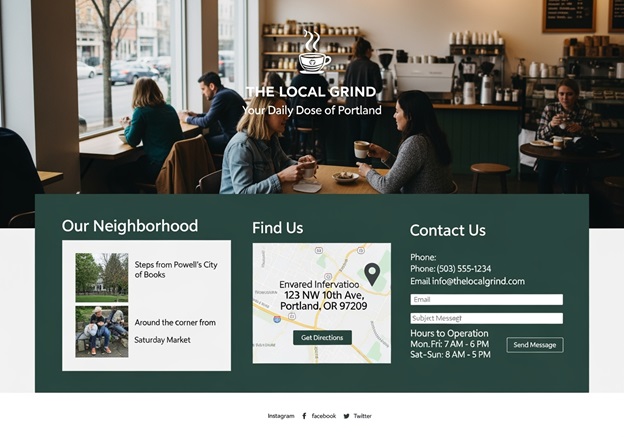
- Embedding a Google Map on Your Contact Page: While it may seem simple, embedding an interactive Google Map on your contact or location pages provides a strong local signal to Google, visually confirming your physical location.
Measuring Success and Preparing for the Future
Local SEO is an ongoing process, not a one-time fix. To ensure your efforts yield results and adapt to the changing search landscape, continuous monitoring and strategic adjustments are essential.
Key Metrics to Monitor
Tracking the right metrics helps us understand what’s working and where improvements are needed.
- Map Pack Rankings: This is arguably the most important metric for local businesses. Tools like Semrush’s Map Rank Tracker can show you how your business ranks for target keywords across different locations, providing a clear picture of your visibility in the local pack.
- Organic Local Rankings: Monitor your website’s ranking for local keywords in the traditional “blue link” organic search results. Google Search Console is invaluable for this, as it shows you which keywords drive traffic to your site.
- GBP Insights: Your Google Business Profile dashboard provides a wealth of data, including:
- How customers find you: Direct searches (searching for your business name) vs. Findy searches (searching for a category or service).
- Views: How many times your profile was viewed on Search or Maps.
- Actions: How many times users called your business, requested directions, or clicked through to your website. Analyzing these actions is crucial for understanding real-world impact.
- Website Traffic from Organic Search: Utilize Google Analytics to track visitors arriving at your website from organic search, with a particular focus on traffic to your location-specific pages.
The Impact of AI on Local Search
The rise of Artificial Intelligence (AI) is changing search, and local search is no exception. AI Overviews (formerly Search Generative Experience or SGE) are increasingly integrated into Google’s search results, providing summarized answers to queries directly at the top of the SERP.
- AI Overviews: These AI-generated summaries may pull information directly from well-optimized Google Business Profiles, website content, and reviews. This means that a comprehensive and accurate GBP, coupled with well-structured website data, becomes even more critical for visibility within these new AI-powered results.
- How Google Sources Information: AI models rely on trusted, structured data. Businesses that have carefully implemented schema markup and maintained accurate, consistent information across their GBP and website are more likely to be featured in AI Overviews.
- Importance of Structured Data and a Well-Optimized GBP for AI Visibility: Structured data helps AI understand your business’s offerings and location with greater precision. A complete and regularly updated GBP provides the AI with reliable, first-party information.
- Preparing for Conversational Search: As voice search and AI assistants become more prevalent, users will ask more conversational, natural language questions. Optimizing your content to answer these questions directly (e.g., “What’s the best bakery near me that’s open late?”) will be key.
Staying agile and adapting to these AI-driven changes will be crucial for maintaining local search dominance in 2024 and beyond.
Frequently Asked Questions about Local SEO
What are the most common local SEO mistakes?
The most common mistakes we see businesses make include:
- NAP inconsistency: Having different names, addresses, or phone numbers across various online listings. This confuses search engines and can hurt your rankings.
- Neglecting your Google Business Profile: Failing to claim, verify, or fully optimize your GBP is a missed opportunity, as it’s the most critical local ranking factor.
- Ignoring online reviews: Failing to encourage new reviews or, worse, not responding to existing ones (especially negative ones) can damage your reputation and prominence.
- Keyword stuffing location names: Over-optimizing by unnaturally incorporating city or neighborhood names into content or GBP fields can be perceived as spammy and may lead to penalties.
How long does it take to see results from local SEO?
The timeline for seeing results from local SEO can vary significantly based on factors such as your industry’s level of competition, your current online presence, and the consistency of your efforts. Generally:
- Initial results: You may start to see improvements in visibility and GBP insights within a few weeks to 2-3 months. This could include more views on your GBP or a slight increase in local keyword rankings.
- Significant impact: For more substantial improvements and a noticeable increase in leads or foot traffic, it typically takes 3-6 months of consistent and strategic work.
- Highly competitive markets: In very competitive industries or locations, it could take 6-12 months or even longer to achieve top rankings. Local SEO is a long-term investment.
Is local SEO a one-time task?
No, local SEO is emphatically not a one-time task. It is an ongoing, continuous process that requires regular monitoring, updating, and engagement. Here’s why:
- Algorithm changes: Search engine algorithms are constantly evolving, requiring adjustments to your strategy.
- Competitor activity: Your competitors are also working on their SEO, so you need to keep pace.
- Business changes: New products, services, hours, or locations require GBP updates.
- Reviews and Q&A: These are dynamic and require ongoing management and responses.
- Content freshness: Regularly adding new, relevant local content keeps your website vibrant and authoritative.
- Citation and backlink maintenance: Ensuring existing citations remain accurate and continuously building new, high-quality links is essential.
Think of local SEO as a garden; it requires continuous tending, watering, and weeding to flourish and yield continuous results.
Ready to lift your local presence and attract more customers? Please find out how our Local Business Digital Marketing services can help your business thrive in the local search landscape. Contact us today for a consultation!