
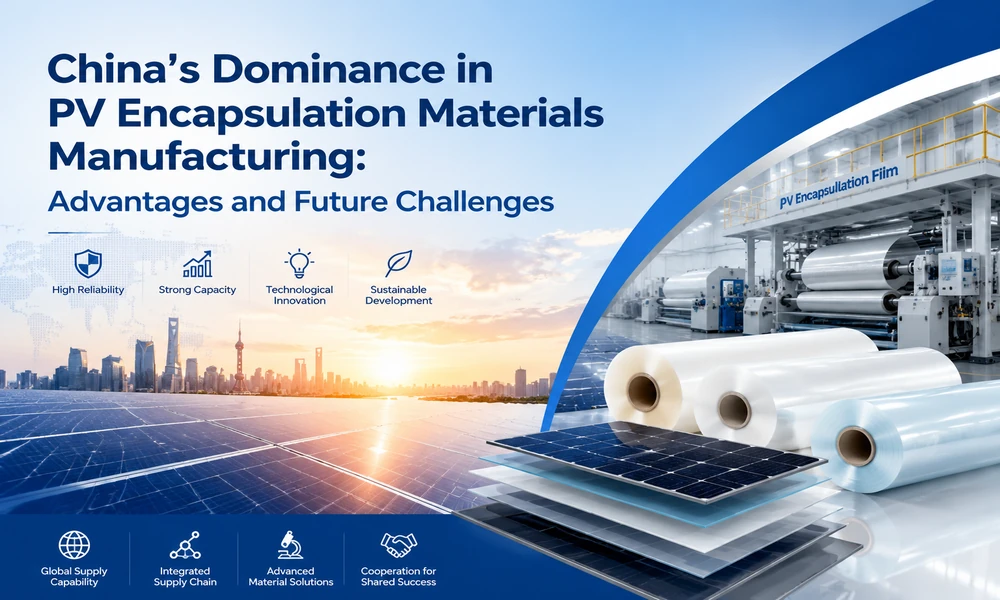
The global photovoltaic (PV) industry has experienced a remarkable transformation over the past two decades, and China has become the most influential force across the solar value chain. While much attention is focused on solar cell technologies, module production capacity, and downstream solar deployment, one critical segment has quietly shaped the industry’s evolution: PV encapsulation materials manufacturing.
Encapsulation films, including EVA, POE, and EPE solar films, serve as the protective layer that connects solar cells with other module components. They directly influence module durability, power retention, moisture resistance, and long-term energy yield. Today, China has established a dominant position in PV encapsulation film manufacturing, supported by large-scale production capabilities, technological innovation, integrated supply chains, and close collaboration with global module manufacturers.
However, maintaining this leadership position will require addressing new challenges, including advanced cell technologies, global supply chain diversification, sustainability requirements, and increasing competition.
The Rise of China’s PV Encapsulation Materials Industry
China’s dominance in PV encapsulation materials did not happen overnight. It developed alongside the rapid expansion of the global solar manufacturing industry.
Over the past decade, China has built a highly integrated PV ecosystem covering:
- Polysilicon production
- Wafer manufacturing
- Solar cell production
- Module assembly
- Encapsulation materials
- Solar equipment and auxiliary materials
This vertically integrated structure created significant advantages for Chinese encapsulation film manufacturers. Close proximity to leading module producers enables faster technical communication, shorter supply chains, and rapid product iteration.
As global PV installations expanded, demand for reliable encapsulation films increased significantly. Chinese manufacturers responded by expanding production capacity for EVA films while simultaneously investing in next-generation materials such as POE and EPE films to support advanced PV technologies.
Key Advantages Driving China’s Leadership
1. Large-Scale Manufacturing Capacity
One of China’s greatest advantages is manufacturing scale.
PV module production has become increasingly concentrated in China, creating strong demand for domestic encapsulation film suppliers. Large-scale factories allow Chinese manufacturers to achieve:
- Higher production efficiency
- Lower manufacturing costs
- Stable supply capability
- Faster delivery times
For global module manufacturers, supply reliability is becoming just as important as product performance. Companies with multiple production bases and regional supply networks can better support customers facing fluctuating demand and logistics challenges.
Leading Chinese encapsulation film manufacturers have expanded beyond single-location production models, establishing manufacturing bases across different regions and overseas markets to enhance supply chain resilience.
2. Mature PV Supply Chain Integration
Another important advantage is China’s complete PV supply chain ecosystem.
Encapsulation film performance depends not only on the film itself but also on its compatibility with:
- Solar cells
- Glass
- Backsheets
- Conductive materials
- Module manufacturing processes
Because Chinese encapsulation suppliers work closely with major module manufacturers, they can quickly optimize materials for different applications.
For example:
- TOPCon modules require improved PID resistance and UV durability.
- HJT modules demand higher chemical stability and low-temperature processing compatibility.
- BC and 0BB technologies require optimized adhesion and optical performance.
- Perovskite tandem modules require encapsulation solutions with enhanced barrier properties.
This close industry collaboration allows Chinese suppliers to accelerate innovation from laboratory development to commercial production.
3. Continuous Technology Development
Although EVA remains the most widely used encapsulation material globally, the industry is moving toward more advanced solutions.
Chinese manufacturers have invested heavily in developing:
POE Encapsulation Films
POE solar films offer excellent moisture resistance and are increasingly used in high-efficiency modules where reliability is critical.
Their advantages include:
- Lower water vapor transmission rate
- Improved PID resistance
- Better protection for sensitive solar cells
EPE Encapsulation Films
EPE co-extruded film combines the advantages of EVA and POE by integrating multiple layers into one structure.
It provides:
- High adhesion performance
- Improved moisture resistance
- Cost advantages compared with pure POE solutions
This makes EPE particularly attractive for N-type module technologies such as TOPCon and HJT.
Functional Encapsulation Films
Future PV applications will require more specialized materials, including:
Chinese manufacturers are increasingly moving from commodity production toward high-value functional materials.
Conclusion
China’s dominance in PV encapsulation materials manufacturing has been built on powerful advantages: massive production capacity, integrated supply chains, technological innovation, and strong cooperation with global PV manufacturers.
However, the next stage of competition will require more than scale. The industry is moving toward higher efficiency, longer lifetimes, smarter manufacturing, and more sustainable materials.
Chinese PV encapsulation manufacturers that successfully combine global supply capability, advanced material development, and application-oriented innovation will continue to play a central role in shaping the future of solar energy.