
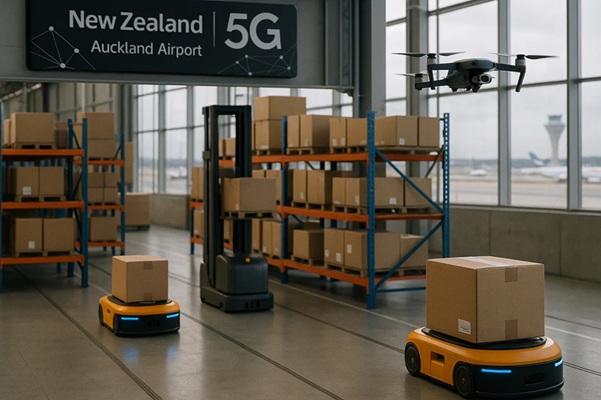
Spark and Air New Zealand recently activated the country’s first private 5G network within an airport logistics facility, powering an automated warehouse system at Auckland Airport. So, now let us look into Autonomous Warehouse Management with Private 5G along with User-friendly LTE RF drive test tools in telecom & Cellular RF drive test equipment and User-friendly Wireless Survey Software Tools & Wifi site survey software tools in detail.
1. Private 5G Network Architecture
- Infrastructure: The network operates on a dedicated slice of 5G spectrum, isolated from public networks to ensure high reliability. It uses Ericsson’s private 5G solution, including baseband units and edge radios tailored for indoor environments .
- Coverage setup: Antennas are strategically placed to provide full connectivity within a 5,000 m² warehouse containing high racks and narrow aisles where Wi‑Fi typically fails
2. Edge Device Integration
- Autonomous Mobile Robot (AMR): A ground vehicle equipped with scanning tools and a tethered drone handles vertical inventory.
- Real-time link: 5G supports uninterrupted streaming of sensor data — simultaneous lidar, video, and telemetry in real time as the devices navigate the space
3. Automated Inventory Workflow
- Daily rollout: The combined robot and drone automatically survey all stock daily, replacing manual walkthroughs done twice a year. This increases data freshness and accuracy while reducing human error and risk.
- Operational flow:
- AMR travels pre-defined routes.
- At each rack, the drone deploys and scans.
- Data uploads instantly to the warehouse management system (WMS).
- Inventory dashboards update in near-real time for monitoring teams
4. Performance Requirements
- Latency: To support collision avoidance and precise navigation, uplink/downlink delay must stay within single-digit milliseconds. Private 5G typically achieves <10 ms in controlled indoor setups.
- Throughput: HD barcode scans and aerial video streams require multi-Mbps uplink capacity per device.
- Reliability: Network is built for non-stop operations — with seamless handover zones to avoid connectivity gaps during robot-drone transitions.
5. Safety Enhancements
- Eliminating manual climbs: Previously, staff scanned inventory manually at heights of up to 15 m — risky and time-consuming. The 5G-powered drone removes that need
- Safety alerts: The system also supports live edge-camera feeds for things like PPE detection around active machinery, with AI running locally or remotely to raise immediate alerts
6. Data and Analytics Layer
- Digital twin readiness: Frequent, granular positional data — timestamped barcode logs, GPS/lidar-tagged scans — provides a foundation for building a live digital twin of the warehouse. This helps with layout simulations, activity forecasting, and predictive maintenance .
- System integration: All time-stamped scans feed into WMS and inventory control modules for automated stock-level triggers and real-time SKU visibility.
7. AI and Computer Vision Applications
- Computer vision use cases:
- PPE detection near moving forklifts or equipment operates via 5G-connected cameras with AI processing at the edge or datacenter
- Presence detection ensures personnel are clear when the drone launches or ground robot navigates nearby.
- AI-driven safety: Frame-by-frame analysis at 30 fps enables immediate alerts to staff and supervisors if non-compliance is detected.
8. Deployment Challenges & Solutions
- RF planning: Warehouse aisles create multipath and shadowing zones. Radio-frequency modeling and floor-plan-driven antenna placement counter these by optimizing small-cell coverage.
- Interference control: Private 5G isolates this network using dedicated spectrum and geo-fencing to avoid interference from public 5G or Wi‑Fi.
- Device tethering: The drone tether ensures continuous power and high-bandwidth connectivity, eliminating the need for onboard batteries and wireless links, which improve flight autonomy and reliability.
9. Operational Outcomes
| Metric | Pre-5G Manual Process | Post-5G Automated System |
| Stocktake frequency | Twice yearly | Daily |
| Inventory accuracy | Moderate (manual error prone) | High (robotic scan/rate sync) |
| Worker exposure to risk | High (climbing racks) | Minimal (ground-level operation only) |
| Data latency | Days (manual counts) | Seconds (real-time upload) |
| Operational cost | High manpower, slow | Reduced labor, faster execution |
10. Future Extensions
- Broader rollout: The plan extends similar private 5G systems across multiple warehouse zones and other industry verticals — manufacturing, ports, and cold storage environments can benefit.
- RedCap IoT: Upcoming RedCap (reduced capability) 5G devices will support low-power sensors for environmental monitoring — making the network more versatile and cost-effective.
- Predictive analytics: The next step is to use machine learning on collected data to predict inventory restocking needs and detect anomalies in storage patterns.
Key Takeaways
- New Zealand’s first private 5G network enables reliable, real-time data transfer in environments challenging to Wi‑Fi.
- A combined drone and ground robot system now performs daily automated inventory audits, improving safety and efficiency.
- The solution supports future AI applications like live worker monitoring and predictive warehouse models.
This deployment offers a blueprint for enterprises aiming to digitize warehouse operations. RantCell users can achieve comparable outcomes—using private 5G for site-specific automation, safety surveillance, and daily inventory management at scale.
About RantCell
RantCell is a powerful mobile network testing tool built for engineers and telecom professionals to assess 2G, 3G, 4G, and 5G network quality using just a smartphone. It enables users to perform drive tests, indoor walk tests, and network benchmarking without requiring any specialized hardware. The platform supports automation, Layer 3 logging, band locking, and live data uploads to a centralized dashboard for detailed analysis. RantCell is suitable for private networks, public operators, and enterprise-grade monitoring. Also read similar articles from here.